A pricing UI that scaled with the business
Console Connect grew into multiple regions. I led the pricing redesign that kept it simple.
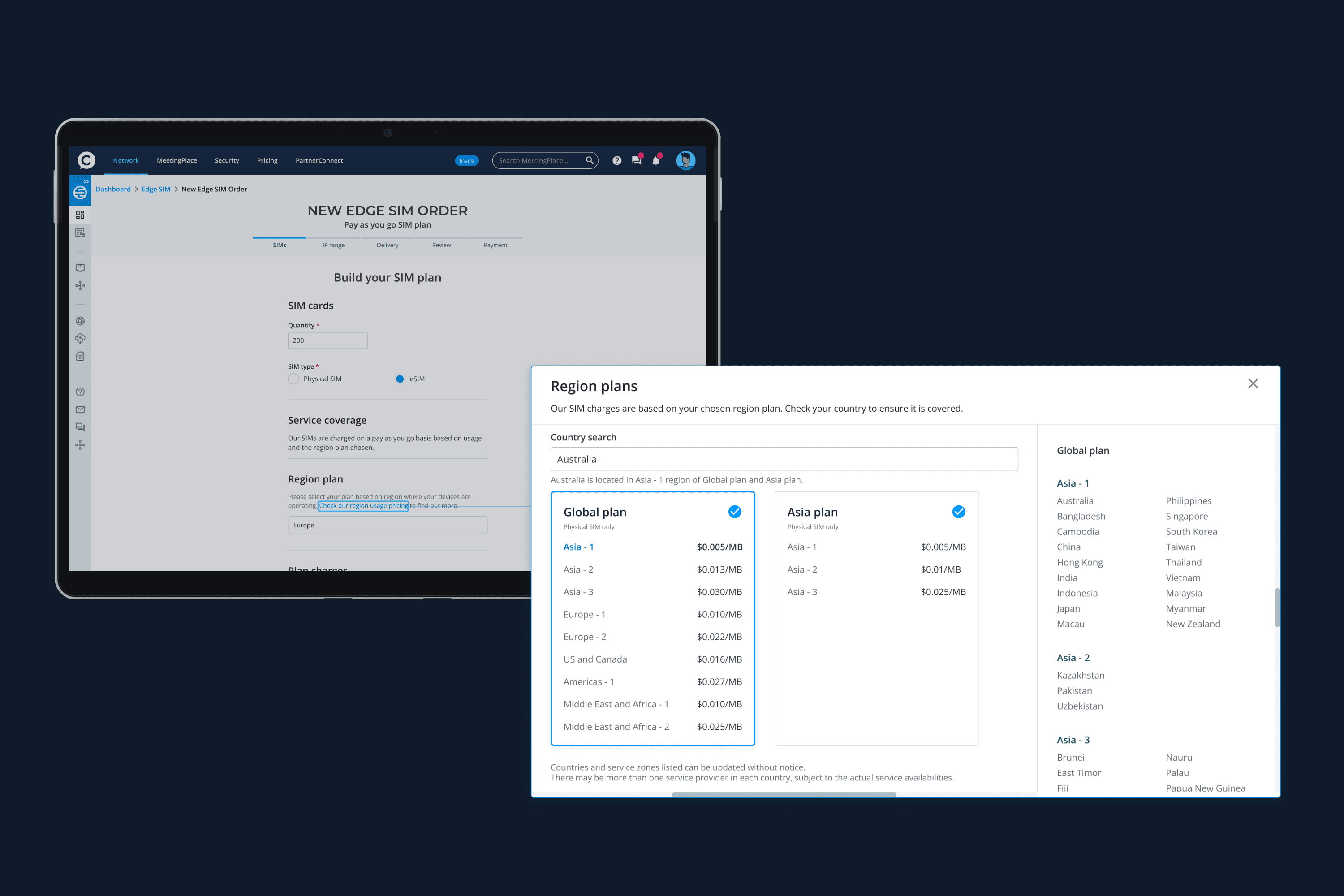
As Console Connect expanded from a single global SIM plan to multiple regional plans and providers, the existing ordering experience was no longer built to handle the growing complexity. I led the redesign of the pricing experience, creating a scalable modal that made plan selection simpler for enterprise customers while supporting future business growth.
Project Highlights
Scalable pricing modal — Built a modular architecture for future plans.
Validated with users — 9 out of 10 admins completed ordering unassisted.
Cross-functional influence — Prototypes aligned Engineering around rebuilding.
ROLE
Lead Product Designer
DURATION
3 Months
RESPONSIBILITIES
Product strategy
UX/UI
Research & testing
Workshops
THE PROBLEM
One global plan was becoming many
Console Connect's Enterprise SIM originally offered a single global data plan.
As the business expanded into regional plans and multiple network providers, the existing pricing model became increasingly difficult to scale. Each new plan introduced more combinations of coverage, pricing and regional rules, while provider information needed to remain hidden from customers.
The challenge wasn't simply adding more plans.
It was redesigning the experience so customers could confidently choose the right plan without understanding the growing complexity behind it.

The existing pricing modal displayed only one global plan. As we onboarded multiple providers with regional pricing variations, this single-plan layout could no longer scale.
THE CHALLENGE
Designing for an unknown future
The business roadmap was still evolving.
Future providers, pricing models and regional offerings hadn't been fully defined, yet the ordering experience needed to launch with an architecture flexible enough to support them.
The solution had to:
simplify pricing decisions for customers
remain scalable as new plans were introduced
minimise future redesign effort

Pricing today is messy: multiple plans, different zone rules inside each plan, and new regional models expected to appear over time.
FINDING THE RIGHT DIRECTION
Make pricing clear, not provider complexity
I led all research and validation activities across stakeholder interviews, design workshops, and usability testing.
Early discussions with PMs, Sales Ops, and Support clarified the business need for provider anonymity and the constraints it introduced.
Testing showed how admins compared plans and assessed coverage, highlighting the need for a clearer hierarchy and progressive disclosure.
These insights led leadership to pursue a full redesign rather than incremental updates.

Mapped the ordering journey with PMs, Sales Ops and Support — comparing pricing plans surfaced as the step admins found hardest.

Three directions were explored internally. The strongest parts of A and B were combined into the final design.

Click heatmap from usability testing showing how users successfully navigated through the ordering flow to complete tasks.
THE TURNING POINT
Patch it or rebuild it?
Engineering initially preferred extending the existing pricing modal because it required less development effort.
I believed the limitation wasn't visual—it was architectural.
Rather than debate it, I built a working prototype and timed the same task on both: the patched modal and the redesigned one. The redesigned version was faster to complete, with fewer wrong turns along the way.
That side-by-side comparison shifted the conversation from opinion to evidence, and aligned Product and Engineering around rebuilding rather than patching.

Mapping the architecture for a patch versus a rebuild showed the patch had no path to filtering across plans. That gap, not a design opinion, is what aligned Engineering and Product around rebuilding.
THE SOLUTION
A pricing experience built to scale
We replaced the single-plan layout with a flexible, provider-agnostic comparison model.

Compare plans with confidence
Regional plans displayed side-by-side, making cost and coverage differences easy to interpret. A horizontally scrollable modal allowed the layout to scale as new plans were added.
Horizontally scrollable modal for viewing multiple regional plans.
Start with where connectivity is needed
Admins could search by country to instantly surface relevant plans, reducing cognitive load and improving evaluation speed.
Search by country to surface covered plans faster.
Reveal complexity only when needed
Detailed coverage opened in a floating panel, preserving clarity in the main view while supporting deeper exploration on demand.
Open a floating panel to see detailed coverage without cluttering the main view.
THE OUTCOME
Beyond the redesign
The redesign moved Enterprise SIM from a single-plan ordering experience to a pricing model that could grow with the business. By separating provider complexity from the customer experience, the same structure could support future regional plans without making the interface harder to understand.
